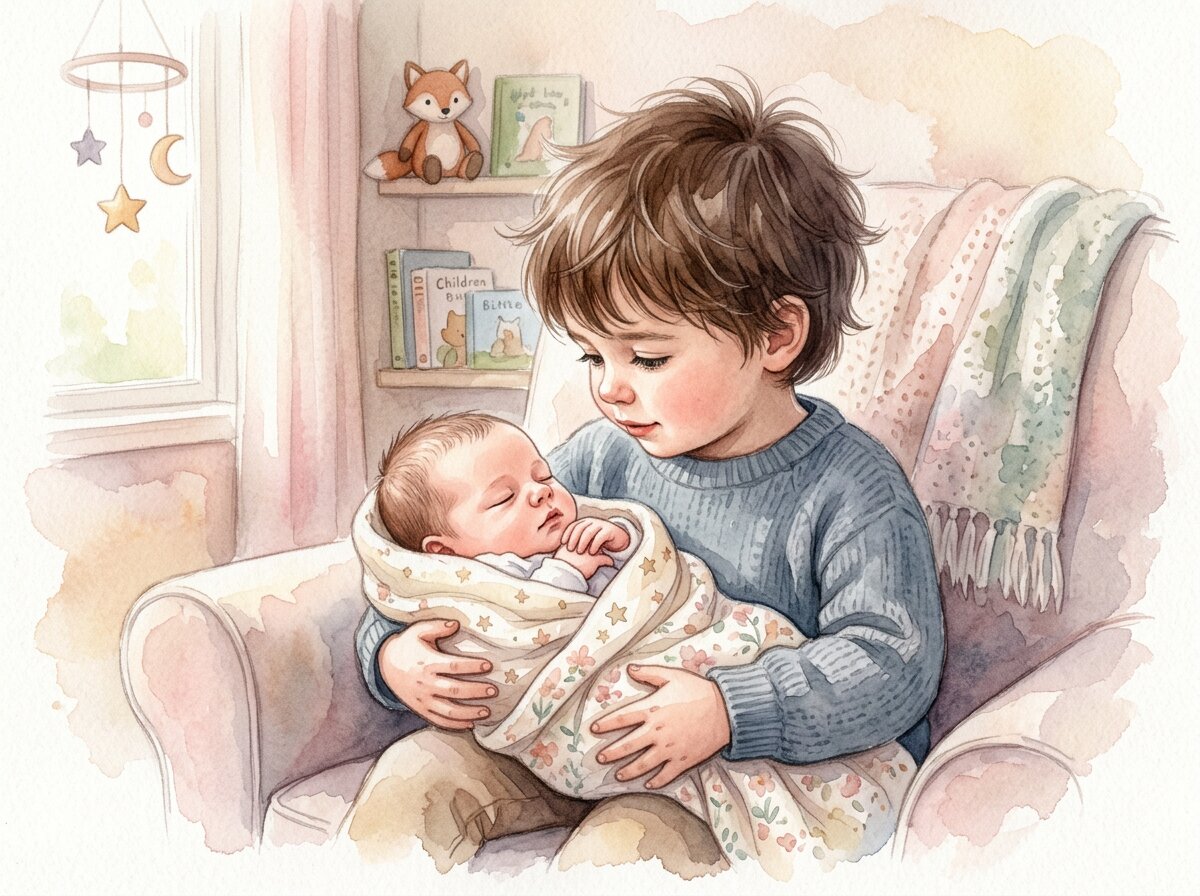
My Friend's 2-Year-Old Was Refusing To Be In The Same Room As Her New Baby Brother...
That’s how Kelvin Pimont (a photography and retouching educator who runs Kelvin Designs, and someone I’ve swapped industry opinions with for years) kicked off a conversation last week. He’s not someone who gets excited about AI tools easily. When he does, I pay attention. What he told me next had nothing to do with cameras or retouching, and somehow everything to do with how I think about the software I recommend on this blog.
Here’s what happened.
The Story
A close friend of Kelvin’s had just brought her second baby home. A little boy, healthy and perfect. Her older daughter, two and a half, was not taking the news well. The jealousy was immediate and intense, the kind that’s exhausting for everyone in the house. The toddler was acting out, clingy, distant from her mom when the baby was around. The usual picture books about new siblings weren’t landing. They were too generic, too removed from what this specific little girl was actually feeling.
Kelvin pointed his friend toward a service called storyfaire.com. She uploaded a photo of her daughter and a photo of the baby. Within seconds, the tool generated illustrated characters that looked like both of them. Then she put together a short prompt: a custom story starring her daughter in the lead role, with her baby brother as a real character, built around what becoming a big sister actually means. The small responsibilities. The things to look forward to. The way the family was growing rather than splitting.
Fifteen minutes later she had a fully illustrated children’s book, personalized down to her daughter’s face and her brother’s.
Within days, the shift was noticeable. The little girl stopped acting out and started leaning in. She wanted to help with the baby. She was talking about being a big sister at preschool. The transformation surprised even her parents.
Why This Belongs On A Product Photography Blog
Bear with me, because the connection is real.
We spend a lot of time in this community arguing about AI. Whether it will replace us, whether it cheapens the craft, whether you can trust tools that are supposed to generate product images or automate background removal or write your listing copy for you. Most of that conversation circles the same drain without going anywhere useful.
What Kelvin’s story gave me is a much sharper question to ask. Not “will AI replace me” but: what does this tool make possible that wasn’t possible before?
A custom illustrated children’s book built around a specific two-year-old in a specific family moment did not exist as something a tired parent could make in fifteen minutes before this. It’s not faster than a thing she could have done herself. It’s not cheaper than a service she could have hired. It’s a thing that simply wasn’t there.
That distinction is the one I want to carry into every AI product evaluation in our niche.
The Three Questions
Here’s the framework I use now. I run every AI tool I’m asked to evaluate through three questions, and I think they’re just as useful for product photography and e-commerce as they are for parenting tools.
1. Is this replacing a craft skill, or expanding what I can do?
If an AI tool is doing the same thing your hands and your eye used to do, you need to ask whether you’re trading the skill away for convenience. A background-removal tool that works well is useful. But if it means you stop learning how to light a product cleanly so you don’t need it in the first place, you’ve made a bad trade. Storyfaire, by contrast, isn’t replacing any skill a parent had. No one had the skill of generating a personalized illustrated book in fifteen minutes. It’s purely additive.
2. Would I lose the underlying skill if I leaned on this for a year?
Think about AI-generated product copy tools. If you run all your listing descriptions through one for twelve months, do you still know how to write a tight, conversion-focused product description when you need to? Maybe not. That’s worth weighing carefully. A tool that makes a category of thing exist that couldn’t exist before sidesteps this question entirely.
3. Does this make something exist that couldn’t exist before?
This is the storyfaire test. For us in e-commerce photography, the equivalent question sounds like: does this tool let me show a client a visual they couldn’t have accessed any other way, at the speed and cost that actually fits their production reality? When the answer is yes, the tool deserves serious attention regardless of your usual skepticism.
Most AI tools pitched to product photographers fail at least one of those three questions. Plenty fail all three. The rare one that passes all three is the one to build into your thinking.
Try It Yourself
If you have a child, a grandchild, or a kid in your life going through a big family transition, this is worth fifteen minutes of your time:
And the next time an AI product lands in your inbox promising to transform your e-commerce workflow, run it through the three questions before you commit. Most of the time the answers will tell you exactly what to do.